
Tabel Of Contents
- Trekking to Everest Base Camp in January Advantages
- Trekking to Everest Base Camp in January Disadvantages
- Weather in January / Winter Season
- Accommodation Situation of EBC in Winter
- Expenses
- How to gear up for the January Trek to Everest Base Camp?
- Alternate Routes
- Are you still doubting about trekking to Everest Base Camp in January?
- Departure Date for EBC Hike in January:2025
- FAQs
- Conclusion
January is the winter season in Nepal, and it is considered an off-season month for trekking in Khumbu and other regions. The trails remain empty with fewer trekkers, and the teahouses are vacant. The freezing cold of the winter season keeps travelers away, also the teahouse owners close the shop and head to lower or warmer places.
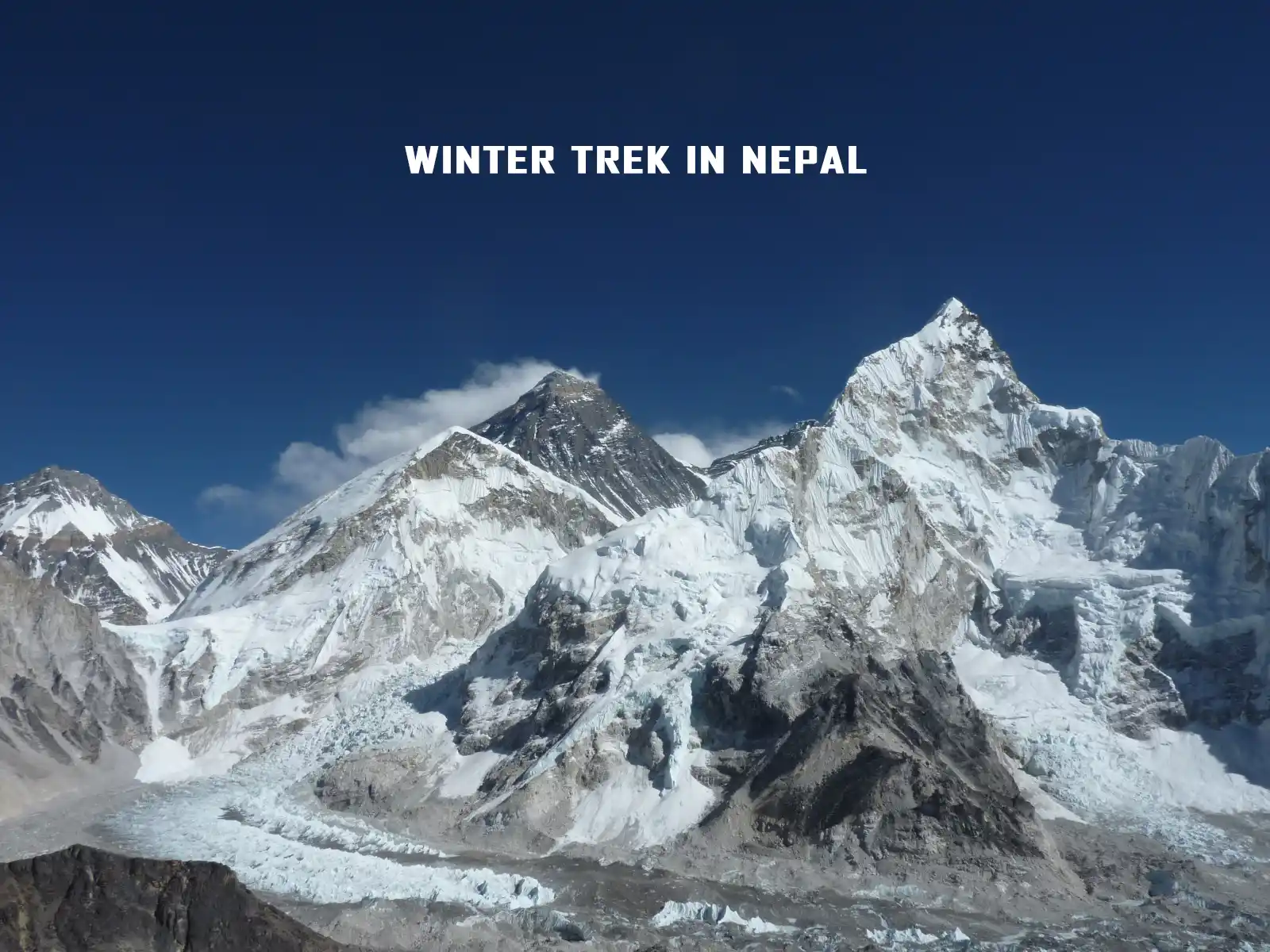
For those sturdy trekkers who can cope with the winter season, January is the perfect month to hit the trail to Everest Base Camp. You can stroll around the beautiful trail in solitude without having to suffer a crowded environment and obstructed trails. The weather remains clear with an open sky for a clear view of mountains, also there’s no precipitation in the air.
Trekking to Everest Base Camp in January Advantages
- First and most of all, you can easily get a seat on the plane to Lukla, and there’s no need to book your ticket in advance (i.e. if you are planning to start your trek by flying directly to Lukla). You can book a ticket a day or two before your trip and it is easily available. You might also get off-season discounts if a company provides an offer.
- In the winter season, the Lukla flights are conducted from the domestic airport in Kathmandu. There is no compulsory to take a 5-hour drive from Kathmandu to Manthali airport in Ramechhap to fly to Lukla, like in the high trekking season.
- Secondly, in winter the route to Everest Base Camp is almost vacant. Unlike the constant flow of trekkers crowding the trail during high trekking season, there will be less trekker hiking at this time of the year. Therefore, there will be no traffic jams at narrow paths and you do not have to wait in line for your turn to check your permit at the check posts. Hurrah!!
- In January, in high altitudes, the air remains dry and there is no precipitation at all in the atmosphere. The weather is very favorable in daytime with the clear skies. You can enjoy wonderful views of the mountains as there will be no fog or clouds blocking your view.
- In the winter season, wild animals living in higher altitudes tend to migrate to the lower valleys, as a result, you might encounter various of wildlife living in the mountains. You might see musk deer, the herds of Himalayan Tahr, red pandas, the pretty and colorful Himalayan monal, and the elusive snow leopard.
- Due to fewer tourists on the trail, some lodges or teahouses offer discounts (on accommodation). If you have your meals at their teahouse then they will provide free shelter to you.
Trekking to Everest Base Camp in January Disadvantages
The night will be extremely cold, especially at the higher altitudes. The temperature will dip below freezing point at night.
The trails above 5000 meters get closed down due to the path getting snowbound. In such case, you might have to abandon your trek to EBC if the trail is closed.
You might suffer from snow blindness, hypothermia, and frostbite.
Most of the lodges and teahouse owners at the higher altitudes close their businesses and move to the valley. However, you will find at least one or two teahouses functioning at each stop where we spend overnight.
You might have to search for a good while for a lodge that’s receiving guests. We recommend you trek with a local guide to save yourself from the uncertainty of getting a room at a teahouse. The guide will know where and which teahouses operate even during freezing winter.
Weather in January / Winter Season
January is a mid-winter in Nepal and it is the coldest month in the Everest (Khumbu) region. In January in higher elevations above 5000 m, the minimum average temperature goes down to as low as -26 degrees Celsius. The lower valleys or the villages of Lukla, Namche, and Tengboche remain a bit warmer with 10 degrees Celsius temperature in the daytime and minimum temperatures dipping below -6 degrees Celsius.
One can also expect fierce winds and snowfall on some days. Sun rises at 7:30 AM and sets usually by 5:30 PM. We advise you to end your trek before sunset because the temperatures outside decrease rapidly after sundown.
In January, the sunlight is intense and the days are warm which results in a real danger of UV exposure. It is advisable to apply sunscreen with a high SPF in your body which will offer good protection from harmful UV rays. Also, using a pair of UV protection sunglasses will shield your eyes from harmful rays. UV exposure can cause snow blindness.
Accommodation Situation of EBC in Winter
In January, most of the guesthouses will be empty, so you won’t have to worry about accommodation. But it is a fact that the teahouses in higher altitudes remain closed down, it’s possible to find at least one lodge open for business even during the off-season.
Since finding a teahouse that remains open in the off-season on your own can be a tough task. So, we advise you to trek with a local guide who can save you from this hassle. Being a local guide he will determine which teahouses remain open and which are closed.
Expenses
Whether it is a peak season or off-season, the price of food menu along the route will remain the same. However, you can expect some discount on the accommodation fee at the teahouses where you will spend your night.
You can shop for snacks in Kathmandu itself and carry them with you as there will be fewer shops open on the trail.
How to gear up for the January Trek to Everest Base Camp?
It is a sure and certain that trekking in January will be super cold, so to be safe from the cold, you need to have appropriate clothes. It is suggested you to carry a good quality down jacket and plenty of warm base layers. A warm hat or cap, a balaclava, down mittens or fur-lined gloves, and socks will save you from the cold and harmful UV rays. A balaclava or buff will protect you from the dreaded Khumbu cough.
Surely, the teahouses will provide you with blankets or quilts but trust us it won’t be enough to keep the freezing cold at bay. So, don’t forget to pack a four-season sleeping bag. A sleeping bag can be an additional insulation that keeps you warm and toasty on cold nights.
Hypothermia and frostbite are real hazards at this time of year, so packing the right clothes may also save your life.
In footer wear, always wear boots that provide good ankle support and are waterproof. For comfort walking on snow and ice, always carry a pair of gaiters and crampons. Trekking poles will help you steer the slippery and icy patches.
Last but not least, always carry essential medicines like Diamox, pills for headaches, diarrhea, or minor pains, muscle pain relief spray or cream, etc.
Alternate Routes
If you want to do another trek rather Everest Base Camp in Khumbu region, you can also trek to the Gokyo Lakes and Sherpa villages in the lower valleys (Debuche, Thame, Phortse, Pangboche, etc). In winter, the Gokyo Valley looks more alluring, covered in snow and ice, it looks like a winter wonderland. For trekkers who love ice skating then the frozen Gokyo Lakes are ideal spots. Figure skating and Ice hockey are two popular outdoor sports among winter trekkers in Khumbu region. The Chola Pass usually gets closed during the winter time.
Are you still doubting about trekking to Everest Base Camp in January?
If you still think trekking to Everest Base Camp is impossible in January, then hear this.
Every winter, a Japanese trekker named Shigeo Osawa trekked to Everest Base Camp to celebrate the new year (1st January). Since 1980, for more than twenty-nine years, he has celebrated his new year by diving into one of the glacial lakes at the Khumbu glacier.
The International Mountain Museum in Pokhara has highlighted his achievement in the Mountain Activities Hall. Do make it a point to check it out, if you ever visit this museum in Pokhara.
A German blogger has also written about encountering Shigeo Osawa at Gorak Shep in 2008. At the exceptional age of 84, Shiego was on his way to Everest Base Camp for his customary New Year’s swim at the highest point on Earth.
It is not impossible to battle the extreme cold at Everest Base Camp in winter and Shigeo Osawa has proved it. Even though he is at the age of eighty, he continued his annual visit in winter to trek to Everest Base Camp and enjoy a swim in the freezing lake waters.
Some mountaineers or adventurers who love winter sports also make it a focus to visit the Khumbu Region in winter. People have played ice hockey and figure-skated on the frozen Gokyo Lake, and skied down Mera Peak.
Departure Date for EBC Hike in January:2025
This January 2025, you can experience the serene beauty of the Mount Everest Base Camp trek. Enjoy a peaceful path, dry weather, clear skies, and direct flights from Kathmandu, making it the perfect time for adventure. All dates listed below are joining dates in Kathmandu, signify Day 1 of the EBC trek.
Our January 2025 departure dates for EBC are: 1, 3, 7, 9, 12, 15, 19, 23, 25, and 27. Secure your sit, and let’s create amazing memories together!
FAQs
Can I trek to Everest Base Camp in January?
Yes, you can trek to EBC during January, but the temperature may be cold. Despite the cold temperature, there are several benefits of doing the Everest trek in January. You don’t need to make an advance booking from Kathmandu to Lukla because the tickets are easily available. The route will be less crowded. The surrounding views of the peaks are wonderful as the sky will be very clear with no fog/clouds. Although it is considered as an off-season month in Nepal, it has a numerous of good factors.
How cold is the weather at Everest Base Camp in January?
January is a mid-winter season in Nepal. In higher valleys, the minimum temperature remains below -20 degrees Celsius while lower valleys like Lukla, Namche, and others experience a bit warmer temperatures about 10 degrees Celsius during the daytime that can go drastically down to -6 degrees Celsius.
Are teahouses in Everest open or closed?
Most of the teahouses may remain closed in the winter season, however, you can find at least one or two lodges open at each stop. The local owners moved to warm areas to get rid of the cold temperatures because of which the lodges remain closed.
What should I pack for the January trek?
Have you made up your mind to trek Everest Base Camp this January 2025? If so, one of the major things you’re probably thinking about is what equipment to pack. Since it’s off-season, preparation plays a main part in successfully completing the trek.
We recommend you bring high-quality sleeping bags, jackets, poles, and trekking boots, which are must-haves. These are the basic requirements, apart from these, there are other important items you should bring with you. Check out our complete blog.
Conclusion
Trekking to Everest Base Camp in January provides a wonderful opportunity to experience some of the world’s highest peaks in the magnificence of their winter season. A winter trek to EBC, with few trekkers on the route, provides a great experience that is hardly and rarely available during the crowded peak seasons.
If you feel like doing adventurous activities on the trail to EBC in January, give us a call. We would love to arrange your trip for you.